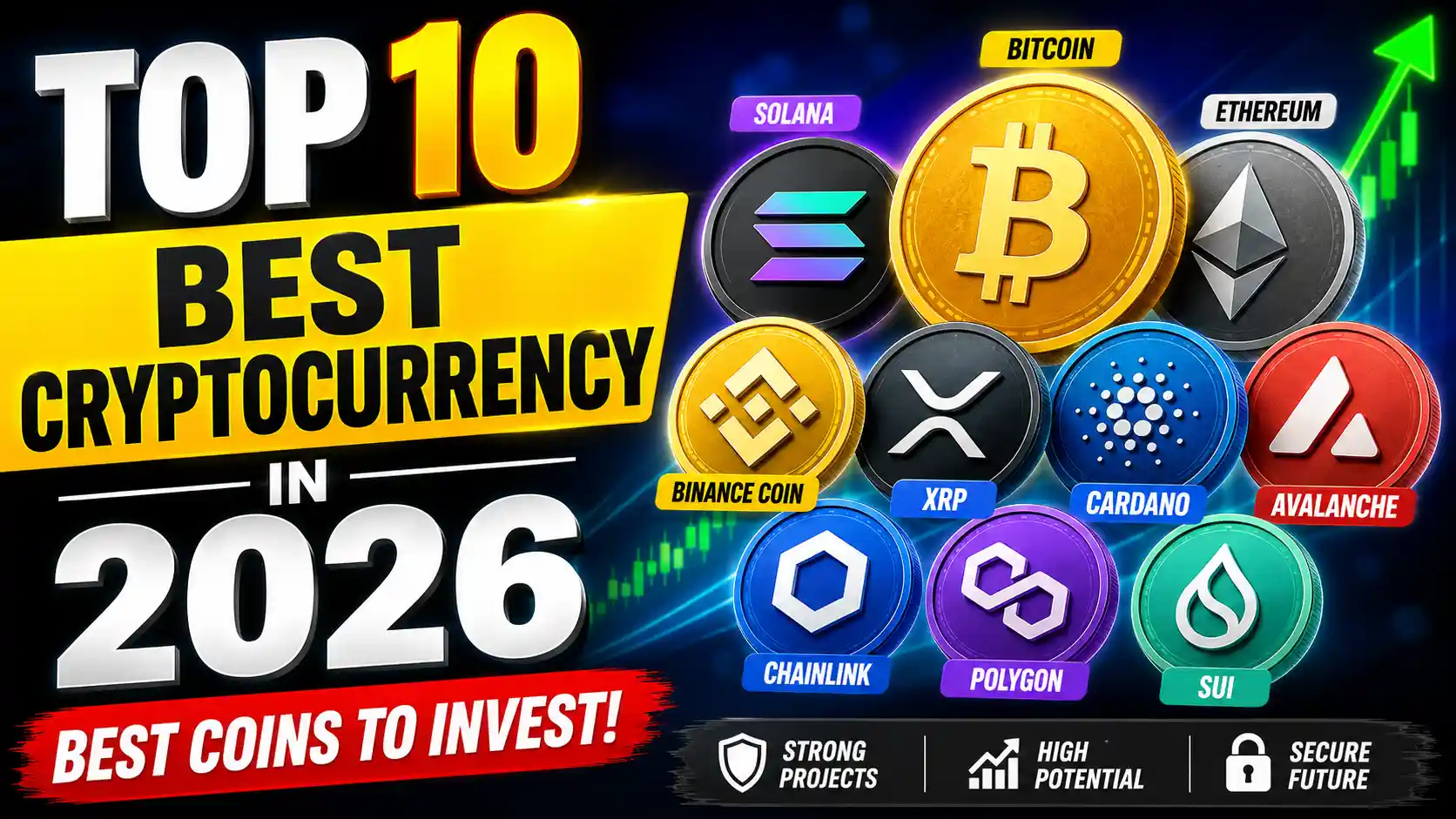
The cryptocurrency market is growing fast in 2026. Many new blockchain projects are entering the market. At the same time, popular cryptocurrencies continue to improve their technology. Investors are looking for coins with strong security, real-world use, and long-term growth potential. This guide explains the Top 10 Best Cryptocurrencies in 2026 in simple English. It is written for beginners as well as experienced investors.
What is Cryptocurrency?
Cryptocurrency is a digital currency. It works without a bank or central authority. It uses blockchain technology to record transactions safely.
People use cryptocurrencies for:
- Online payments
- Investing
- Trading
- Sending money internationally
- Decentralized Finance (DeFi)
- Gaming
- NFTs
- Smart Contracts
Today, thousands of cryptocurrencies are available. However, only a few have strong technology and long-term value.
Why Invest in Cryptocurrency in 2026?
The crypto market has become more mature than before.
Some reasons why many investors are interested include:
- Better blockchain technology
- Faster transactions
- Lower transaction fees
- Growing institutional investment
- More government regulations
- Higher adoption worldwide
- AI and blockchain integration
- Expansion of Web3 applications
Although the market is still volatile, many experts believe crypto will continue growing over the next several years.
Things to Consider Before Buying Cryptocurrency
Always research before investing.
Consider these factors:
| Factor | Why It Matters |
|---|---|
| Market Cap | Shows overall value |
| Technology | Better technology often lasts longer |
| Security | Protects user funds |
| Community | Active communities support projects |
| Development Team | Strong developers improve the project |
| Use Cases | Real-world applications increase demand |
| Liquidity | Easy buying and selling |
| Token Supply | Limited supply may increase value |
Top 10 Best Cryptocurrency in 2026
1. Bitcoin (BTC)
Overview
Bitcoin remains the king of cryptocurrencies.
Created in 2009, Bitcoin is still the largest digital currency by market capitalization.
Many investors call Bitcoin “Digital Gold.”
Why Bitcoin is Good
- Highest market value
- Strong security
- Limited supply (21 million)
- Accepted worldwide
- Popular among institutions
Advantages
- Long history
- Trusted globally
- Good long-term investment
- High liquidity
Risks
- Price volatility
- Slow transaction speed compared to newer blockchains
2. Ethereum (ETH)
Ethereum is the biggest smart contract blockchain.
Thousands of applications run on Ethereum.
Developers use Ethereum to build:
- DeFi platforms
- NFTs
- Crypto wallets
- Blockchain games
- AI applications
Why Ethereum?
- Huge ecosystem
- Strong developer community
- Regular upgrades
- Smart contract leader
Best For
- Long-term investors
- Developers
- NFT creators
3. Solana (SOL)
Solana is one of the fastest blockchain networks.
It offers low fees and high transaction speed.
Many gaming and NFT projects use Solana.
Features
- Fast transactions
- Low gas fees
- Large ecosystem
- Strong developer support
Advantages
- Excellent performance
- Growing adoption
- Scalable blockchain
4. Binance Coin (BNB)
BNB powers the Binance ecosystem.
It is used for:
- Trading fee discounts
- Payments
- DeFi
- Gaming
- NFTs
Benefits
- Strong ecosystem
- High utility
- Regular token burns
- Growing demand
5. XRP (Ripple)
XRP focuses on international money transfers.
Banks and financial institutions use Ripple technology.
Why XRP?
- Fast payments
- Low transaction cost
- Banking partnerships
- Energy efficient
Best For
People who believe blockchain will improve global banking.
6. Cardano (ADA)
Cardano focuses on scientific research and security.
Its blockchain is energy efficient.
Many developers build educational and financial projects on Cardano.
Advantages
- Eco-friendly
- Secure
- Research-based development
- Growing ecosystem
7. Avalanche (AVAX)
Avalanche offers fast transactions with low fees.
It supports smart contracts and decentralized applications.
Features
- High speed
- Low costs
- Scalable network
- Enterprise adoption
8. Chainlink (LINK)
Chainlink connects blockchains with real-world data.
It powers many DeFi applications.
Why LINK?
- Oracle leader
- Used by many blockchain projects
- High demand in smart contracts
9. Polygon (POL)
Polygon continues to improve Ethereum scaling.
It offers cheaper and faster transactions.
Many companies use Polygon for blockchain solutions.
Benefits
- Ethereum compatible
- Low fees
- Strong partnerships
- Large ecosystem
10. Sui (SUI)
Sui is becoming one of the fastest-growing blockchain networks.
It focuses on scalability and user experience.
Many developers are building Web3 applications on Sui.
Advantages
- High speed
- Modern blockchain design
- Growing ecosystem
- Strong developer interest
Top 10 Cryptocurrency Comparison Table
| Cryptocurrency | Symbol | Main Use | Risk Level | Long-Term Potential |
| Bitcoin | BTC | Store of Value | Medium | Excellent |
| Ethereum | ETH | Smart Contracts | Medium | Excellent |
| Solana | SOL | Web3 & Gaming | Medium | High |
| Binance Coin | BNB | Exchange Ecosystem | Medium | High |
| XRP | XRP | Global Payments | Medium | High |
| Cardano | ADA | Smart Contracts | Medium | High |
| Avalanche | AVAX | DeFi | High | High |
| Chainlink | LINK | Blockchain Oracle | Medium | High |
| Polygon | POL | Ethereum Scaling | Medium | High |
| Sui | SUI | Web3 Applications | High | High |
Benefits of Investing in Cryptocurrency
There are many advantages.
High Growth Potential
Some cryptocurrencies have delivered strong returns over long periods.
Global Accessibility
Anyone with internet access can buy crypto.
Inflation Protection
Many investors use Bitcoin as protection against inflation.
24/7 Market
Crypto markets never close.
Decentralization
No single authority controls most cryptocurrencies.
Innovation
Blockchain continues creating new business opportunities.
Risks of Cryptocurrency
Every investment has risks.
These include:
- Market volatility
- Government regulations
- Security threats
- Scams
- Exchange failures
- Project failures
- Wallet hacking
- Emotional trading
Never invest money you cannot afford to lose.
Tips for Beginners
If you are new to crypto, follow these simple tips.
Start Small
Do not invest all your money at once.
Diversify Your Portfolio
Avoid investing in only one cryptocurrency.
Use Trusted Exchanges
Always use well-known crypto exchanges.
Store Coins Safely
Use hardware wallets for large investments.
Keep Learning
Read news daily.
Understand market trends before making decisions.
Avoid FOMO
Never buy only because everyone else is buying.
Think Long Term
Many successful investors hold quality cryptocurrencies for years.
Future of Cryptocurrency in 2026
The crypto industry continues to evolve.
Several trends are shaping the market:
AI and Blockchain
Artificial Intelligence is helping improve blockchain applications and automation.
Tokenization of Real Assets
Real estate, stocks, and other assets are increasingly being represented on blockchains.
Institutional Adoption
More financial companies are offering crypto-related products and services.
Stablecoins
Stablecoins are becoming more widely used for payments and cross-border transfers.
Web3 Growth
Web3 platforms are creating decentralized social media, gaming, and finance applications.
Improved Regulations
Many countries are introducing clearer rules for cryptocurrencies, which may encourage broader adoption.
Overall, 2026 is expected to be an important year for blockchain innovation and digital assets.
Frequently Asked Questions (FAQs)
1. Which cryptocurrency is the safest in 2026?
Bitcoin is generally considered the safest because of its long history, strong security, and large market capitalization.
2. Is cryptocurrency a good investment in 2026?
It can be, but it also carries risk. Research carefully and invest according to your financial goals.
3. Which crypto has the highest growth potential?
Projects with strong technology and active ecosystems, such as Ethereum, Solana, and Sui, are often discussed for growth potential. However, future performance is never guaranteed.
4. Can beginners invest in cryptocurrency?
Yes. Beginners can start with small amounts and learn before investing more.
5. Should I invest only in Bitcoin?
Many investors diversify by holding several cryptocurrencies instead of only one.
6. What is blockchain?
Blockchain is a secure digital ledger that records transactions across many computers.
7. Can I lose money in crypto?
Yes. Cryptocurrency prices can rise or fall quickly, and losses are possible.
8. What is the best wallet for crypto?
Hardware wallets are generally considered safer for storing larger amounts. Software wallets can be suitable for everyday use.
9. Is Ethereum better than Bitcoin?
They serve different purposes. Bitcoin is mainly viewed as a store of value, while Ethereum powers smart contracts and decentralized applications.
10. How much should beginners invest?
Start with an amount you are comfortable losing. Build knowledge before increasing your investment.
Final Thoughts
Cryptocurrency continues to be one of the most exciting investment sectors in 2026. While many new coins appear every year, only a small number have strong technology, active development, and real-world adoption.
For many long-term investors, Bitcoin and Ethereum remain the foundation of a crypto portfolio because of their maturity and broad acceptance. Projects like Solana, BNB, XRP, Cardano, Avalanche, Chainlink, Polygon, and Sui also offer unique strengths and continue to expand their ecosystems.
Remember that no investment is risk-free. Prices can change rapidly, and past performance does not guarantee future results. Always research each project, diversify your investments, use secure wallets, and avoid investing based on hype alone.
A disciplined approach, patience, and continuous learning are the keys to becoming a successful cryptocurrency investor.
Disclaimer
This article is for educational and informational purposes only. It should not be considered financial, investment, tax, or legal advice. Cryptocurrency investments are highly volatile and involve significant risk. Always conduct your own research (DYOR) and consult a qualified financial advisor before making any investment decisions. The cryptocurrency market can change quickly, and future performance cannot be guaranteed.